




This article was updated on March 7th, 2022
Older dog heart murmurs, diseases and problems are fairly common, and your senior dog may develop some type of heart disease… eventually.
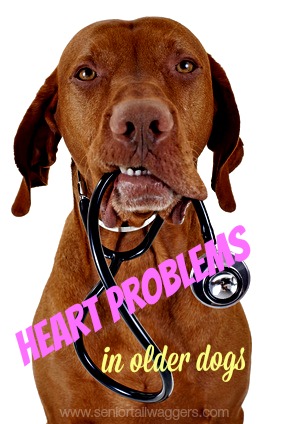
This is because the heart is a very complex organ. As your dog’s body ages, so do the vital organs keeping the body going. This includes his major organs such as the heart, liver and kidneys.
But if you’re worried about witnessing a sudden dog heart attack, don’t be. Dogs generally don’t have ‘heart attacks’ the way people do. They also don’t have problems with their cholesterol levels or blood pressure (unless they’re in heart failure).
But heart disease can, and does, happen to dogs, just the way it does to people. One of the most common issues is “heart murmurs” (Read: Heart Murmurs in Older Dogs). A heart murmur is an abnormal sound produced by the heart that you can hear when listening with a stethoscope. Heart murmurs can be innocent but they can also indicate a defect which can eventually lead to heart failure.
Luckily, when symptoms of degenerative canine heart disease are spotted early, they can often be treated or managed, so that your dog gets to spend more time enjoying a quality life with you.
Sometimes a puppy is born with a heart condition, or it can be damaged by disease or parasites… but this page is going to focus on the most common heart problems that affect our older dogs – Heart Murmurs, Mitral Valve Disease and Congestive Heart Failure. And although dog heart attacks are rare, occasionally a myocardial infarction (the correct medical terminology for a heart attack) can happen, so also included is a short section on the symptoms, diagnosis and treatment of a Dog Heart Attack.
1. Heart Murmurs
A heart murmur simply refers to the presence of abnormal sound produced by the heart, heard when listening with a stethoscope.
These extra sounds come from turbulent blood flow within the chambers of the heart and usually appear and disappear between the normal beating sounds of the heart. A murmur can be high-pitched, low-pitched, long or short, or can even be continuous/constant.
The presence of a heart murmur doesn’t always indicate disease; some low-grade heart murmurs can be innocent such as physiological murmurs which can come and go with changes in heart rate – although these kinds of murmurs are more common in younger dogs.
However, many heart murmurs do indicate a defect within the heart which can eventually lead to heart failure – these are caused by a structural abnormality within the heart that may affect the valves or muscles of the heart.
Learn more with our article: Heart Murmurs in Older Dogs.
2. Mitral Valve Disease

Dog heart valve problems are the most common type of canine heart disease: studies indicate that between 30% and 75% of senior dogs will develop Mitral Valve Disease (also known as MVD). The disease is particularly prevalent in smaller dogs & breeds such as the Cavalier King Charles spaniel, with as many as 90% developing the disease by the age of 10 years – Source.
The aging process naturally causes your dog’s organs and systems to deteriorate, including the valves which keep the blood moving forwards through the heart. This more commonly occurs to the mitral valve, on the left side of the heart.
When a valve begins to degenerate, blood starts to leak backwards into the previous chamber of his heart called the ‘left atrium’. When it does this regularly, that chamber becomes enlarged and the heart muscles become thickened, as they have to pump extra hard to make up for the backflow of blood. That in turn puts extra strain on the heart valves, and it becomes a vicious circle.
If it’s left untreated, degenerative valve disease like this can become canine congestive heart failure, so early detection and treatment is really important.
Symptoms of Dog Heart Valve Disease

The very first symptom of this condition is a heart murmur.
Although heart murmurs in puppies and adult dogs can be caused by other issues, the sudden appearance of a heart murmur in an older adult dog (who has never had this problem before) is most likely going to be due to a faulty valve.
This isn’t something that you can see, so if your dog isn’t getting regular veterinary check-ups it can go un-noticed until the problem is severe enough to cause other symptoms.
Annual veterinary check-ups can make sure any older dog heart problems are picked up early and are treated properly to minimize any damage!
If it’s left untreated, more symptoms will start to appear – and these ones you will be able to see.
But, sometimes the symptoms of older dog heart problems come on slowly, over a period of time, are mild enough not to raise a red flag early on or are confused with symptoms of another condition.
However, the earlier on in the course of the disease it is treated, the better the prognosis and success of treatment.
It’s important to watch for signs of heart trouble in our older dogs. These symptoms can include:
- Exercise intolerance (your dog can’t run or play much, or refuses to try)
- Lethargy and excessive sleeping
- Heavy panting or rapid breathing
- Coughing (especially after exercise or after waking up in the morning).
Treating Mitral Valve Disease In Older Dogs
If your dog is diagnosed with valve disease while it’s still in the very early stages (i.e. diagnosed incidentally at an annual check-up with no concurrent symptoms), he may not need any immediate treatment if he seems healthy otherwise.
Annual, or bi-annual check-ups, and either x-rays or an echocardiogram every year or two will let your veterinarian monitor his condition and step in as soon as necessary.
When it’s got to the point where your vet feels it’s necessary to start treating older dog heart problems like this, there are several medications that can help keep your dog’s heart functioning properly.
This will prevent, or reduce, any symptoms he’s having and can often also slow down the rate at which the condition would normally advance.
Scroll down, or click on this link, to find more information on these symptoms
Interesting Information… Dog Heart Rate
A normal dog heart beats faster than the human heart does… and the smaller your dog, the more rapidly his heart is going to beat.
Every dog is a little different and general health, normal activity level and other things can factor in.
But here are some guidelines for the average ‘resting’ normal dog heart rate figures, (measured in beats per minute)…
X-small or tiny/toy breeds: 100 – 140 beats per minute
Small breeds: 90 – 140 beats per minute
Medium breeds: 80 – 120 beats per minute
Large and giant breeds: 70 – 120 beats per minute
3. Congestive Heart Failure
The end-stage of mitral heart valve disease in older dogs is congestive heart failure. This is just the natural progression of the condition. Your senior dog’s heart has been pumping hard his whole life, and the wear-and-tear of those years isn’t reversible..
According to the American Veterinary Medical Association, 60% of senior dogs are at risk of developing heart failure. Congestive heart failure can cause many different symptoms and eventually leads to fluid build up in the lungs which interferes with breathing.
The good news is that medication and the right care can slow down the progress of older dog heart problems, if the condition is caught early enough.
Plus treatment will make your dog feel much better and improve the quality of his life.
Congestive Heart Failure Symptoms
The symptoms of congestive heart failure in dogs include many of the more serious symptoms of mitral valve disease.
These include:
- An inability to, or lack of interest in, any sort of exercise or physical activity
- Heavy, chronic panting (even when Fido is resting)
- Restlessness, pacing, signs that your dog isn’t comfortable
- Rapid breathing, or difficulty breathing
- Low energy levels, or lethargy
- A dry ‘barking’ or ‘hacking’ cough (especially after exercise, or on waking up)
- Weight loss or loss of appetite
- Excessive drooling
- Pale (or blue/gray) gums and/or tongue
- Abdominal swelling (caused by fluid build-up)
- Fainting or collapse (can be caused by an irregular heartbeat)
When your veterinarian examines your dog, he will be able to hear the abnormal blood flow through the heart and may also notice an irregular heartbeat.
An X-ray, ECG or an ultrasound exam will show the physical signs of heart failure such as the enlarged heart chambers.
Treating Congestive Heart Failure In Dogs
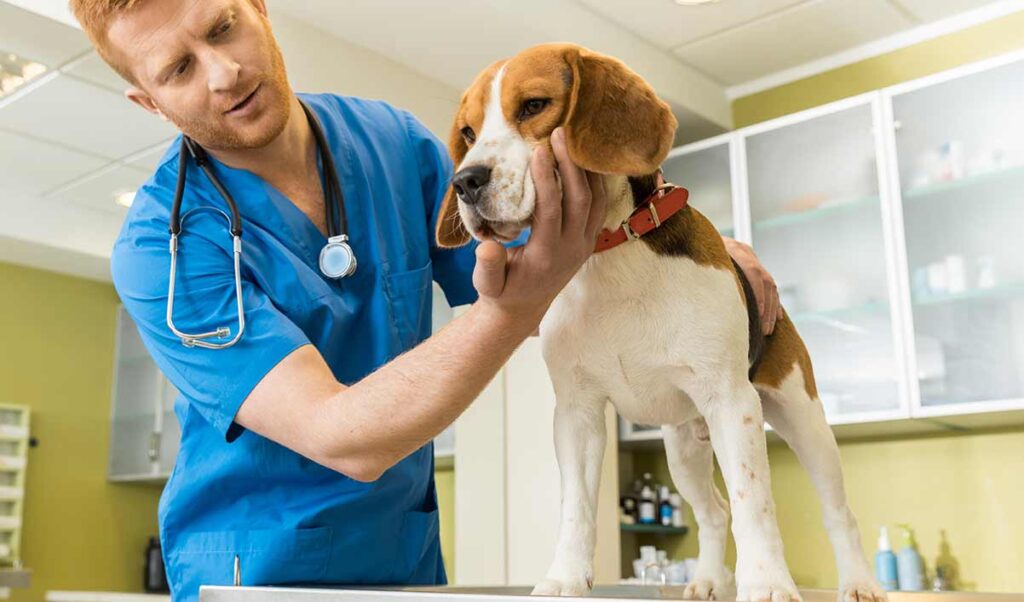
The earlier treatment is started, the better the prognosis for your dog because the damage done to his heart will be minimized through promptly reducing the strain on the heart structures.
There are a few different medications that your veterinarian might prescribe to treat your older dog if he is diagnosed with valve disease or heart failure.
These might include:
ACE inhibitors – these dilate arteries and veins which improves blood flow and lowers blood pressure.
Positive Inotropes – this helps to improve the strength of the heart muscle’s contractions.
Diuretics – these are used to help improve kidney function to speed up the removal of excess fluids that have built up in your dog’s body, particularly from the lungs.
Blood-thinners – sometimes your veterinarian may recommend that you give your dog Aspirin, or something similar, to prevent blood-clots from forming.
Although they’re not a treatment, and shouldn’t replace your veterinarian’s recommendations, natural supplements can also be used to give your dog’s heart the maximum amount of help.
These include amino acids such as L-carnitine and taurine, antioxidants like CoQ10, and omega-3 fish oils. Lifestyle and/or dietary changes can also play a role in caring for an older dog with heart problems. Learn more about the best ways to care for a dog with congestive heart failure or when to euthanize a dog with congestive heart failure.
4. Heart Attacks
Sometimes owners think their dog has had a heart attack because they die suddenly, and there are no other obvious causes. What’s more likely is that mitral valve disease (MVD) or the resulting congestive heart failure is really to blame, but many owners do not opt for an autopsy, meaning that undiagnosed conditions are not picked up.
A heart attack happens when one of the coronary arteries becomes clogged or blocked by plaque or other debris, reducing (or occasionally even cutting off) the hearts’ blood supply.
Dog Heart Attack – Symptoms
The symptoms of a heart attack in dogs are very similar to those of MVD or heart failure.
They can include:
- Difficulty breathing
- Irregular heartbeat
- Weakness
- Lethargy
- Vomiting
- Excessive panting
- Collapse
- Seizure
- Sudden death
Dog Heart Attack – Diagnosis & Treatment
Sadly, the first sign of a heart attack in dogs is sudden death, this can also be true of canine heart failure.
Having owned a Rottweiler who died out of the blue from a heart condition, and an Olde English Bulldogge puppy who died tragically and unexpectedly from what an autopsy concluded was a heart problem, I know first-hand the heartbreak of being in this situation.
However, if you (and your dog) are fortunate enough for his heart attack to NOT be instantly fatal, then getting him immediate veterinary care just might save his life.
Your veterinarian has a slew of tests that he can perform to find out what’s happening inside your pets’ heart (as well as to look for underlying disease that could be causing/contributing to the problem).
These will help him to decide what treatment is the best option.
These tests might include a full physical exam, blood tests, urinalysis (testing his urine, an ECG, X-rays and ultrasound exams.
Treatment options will obviously depend on the reason for the symptoms (which might well not be caused by a heart attack at all), his age and his general health.
He will probably be admitted to the veterinary hospital and given resuscitation if needed, as well as IV fluids or any emergency medications that your vet deems necessary.
Once he’s stable, he will most likely be prescribed medications to break up blood clots (if there are any), or to regulate his heart rhythm or blood flow.
Whether or not he has to stay in the vet hospital for a while will depend entirely on the individual circumstances and his condition.
Even once released to go home, a dog with heart problems will need to be closely (and regularly) monitored by his veterinarian, and most likely take medications for the rest of his life.
Prognosis For Older Dogs With Heart Problems

It’s impossible to give a definitive answer to the question of how long a dog can live with heart disease.
That’s because a lot depends on the type/cause of the heart problems, as well as how early they’re diagnosed.
If dog heart valve problems are spotted at the very early ‘heart murmur stage’, and monitored carefully, then it’s perfectly possible for him to live with it for years.
But if your dog isn’t diagnosed until he’s showing symptoms of congestive heart failure then more damage has already been done, and the time he has left is obviously going to be shorter.
Quality of life is something else you must factor into the equation.
While a dog in late-stage heart failure may physically be able to continue to breathe, he may be in a lot of pain or discomfort, as well as having difficulty breathing and possibly feeling anxious.
BUT, the medications used to control and treat older dog heart problems can be effective, in giving him more time as well as improving his quality of life.
Your veterinarian is the best person to talk to about your dog’s prognosis as he/she knows the symptoms, damage, treatment options and so on that are unique to him.
Author
Disclaimer: This website's content is not a substitute for veterinary care. Always consult with your veterinarian for healthcare decisions. Read More.